I don't want to spoil the ending, but everything is going to be OK.
I don't want to spoil the ending, but everything is going to be OK.
Originally published on LinkedIn
Originally published on LinkedIn.
I don't want to spoil the ending, but everything is going to be OK.
I have three things to tell you about.
An email came in this morning. I read it four times. The tone felt slightly abrupt. The word "circling" left me concerned. There was no jovial toodles signoff.
I sent an IM. I spent a significant amount of time waiting for three animated dots to appear. When they did, I got three minutes of bouncing periods, and then the answer arrived. "OK."
When the dots go for three minutes and then you get "OK," do you feel disappointed too? I imagined the sender hunched over their keyboard, typing, deleting, typing again, and finally giving up with a loud exhale and sending "OK."
Or they were really good at subterfuge, playing with me because they knew I was watching. The stories are endless.
There was a meeting this week. A redux of last week, which I attended. I know because four people asked "Can you hear me?", which is double the average. This week's I was not invited to. Not that I wanted to go. But being denied the small pleasure of declining with a "Sorry, getting rhinoplasty at this time" was not fair.
These three things might suggest I am, technically, paranoid. Can I suggest you have felt some version of these recently?
Here's the point: I am really good at my job, but the "worst thing ever" could happen to me at any time.
You know how everyone says you shouldn't research your symptoms on the internet, because you'll spend twenty minutes convinced you're growing a second head out of your armpit?
Well.
I decided I would research the state of corporate America.
The short version: it's a horror film where the walls start bleeding, and instead of running away screaming, someone says, "That's strange. We should probably get a mop." And everyone else agrees.
A quarter of workers have considered quitting their jobs because of the toll on their mental health. Eighty percent have personally experienced or witnessed quiet firing. Add to that the specter of AI doing all our jobs and leaving us on the street. Pro tip: if we are all broke and homeless, who is going to buy the goods that AI is making for us?
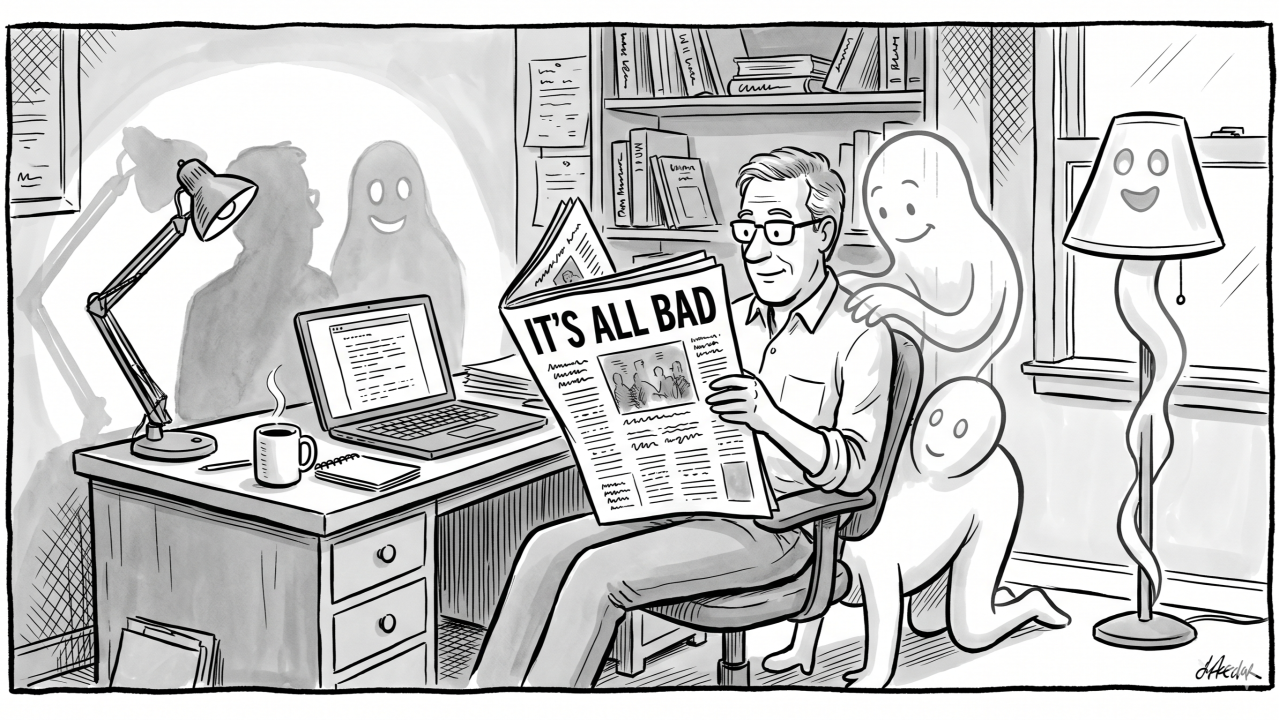
The news is fatalistic because fatalism sells, and what we read shapes what we expect. All of this is around us. The only thing in our control is how we react.
Let me go back to the three things I told you about.
Just full disclosure: I made them up. (Or did I?)
Either way, here is what was actually happening underneath.
The email wasn't about the email. The part of me studying the punctuation was scanning for danger, looking for evidence that the thing I am afraid of is starting to happen. Reading it four times didn't get me closer to an answer. It just felt like it did.
The IM that ended in "OK" was three minutes of nothing. I filled it with anxiety. The image of the sender wrestling with the reply was a story that made me feel like I mattered. The image of subterfuge was a story that made me feel justified in being suspicious.
The meeting I wasn't invited to is closer to something real. A part of me wanted to be included. It has a backstory from childhood, which is a funny story for another time. That part is doing what it has always done — reaching for the room I'm not in and trying to find a way back into it.
Once I noticed the part, the meeting stopped being a problem. I was in the original. I did not need to be in the redux.
The reason I can describe any of this is because of two people.
Brené Brown gave me the language. The phrase she made famous — the story I'm telling myself — is what the brain hands you when uncertainty abounds.
Richard Schwartz gave me the map. The short version: you're not one self, you're many parts. Some of them are protective — the one rereading the email, the one scanning for tone, the one trying to stay ahead of the bad outcome. They developed from lived experience, usually nothing to do with the situation you are actually in.
Underneath them is something steadier. The part of you that can notice what's happening without immediately becoming it.
That's the useful skill. Not eliminating the reaction, but not being run by it.
That's what I wanted to tell you.
I read emails multiple times, watched three minutes of bouncing periods, and missed a meeting I wouldn't have wanted to attend. So did you, in some version.
The data says it may feel like this for a while.
The frameworks say you don't have to lose yourself inside it.
I don't want to spoil the ending.
But everything is going to be OK.
If you want to go deeper:
Dare to Lead by Brené Brown — the practical version of her work. Trust, hard conversations, what it actually looks like to show up.
No Bad Parts by Richard Schwartz — the accessible introduction to Internal Family Systems. The title is the argument.
Sources:
NAMI-Ipsos Workplace Mental Health Poll, 2026 — a quarter of workers have considered quitting because of the toll on their mental health.
LinkedIn News poll, 20,000+ respondents — 80% have personally experienced or witnessed quiet firing.
#MentalHealthAwarenessMonth #WorkplaceMentalHealth #SelfAwareness #stopreadingthenews #hashtagsarearealpain